
CV or Resume in Australia? What to Actually Submit
Confused about whether to send a CV or a resume in Australia? Here's what employers actually expect, and how to tell from the job ad.
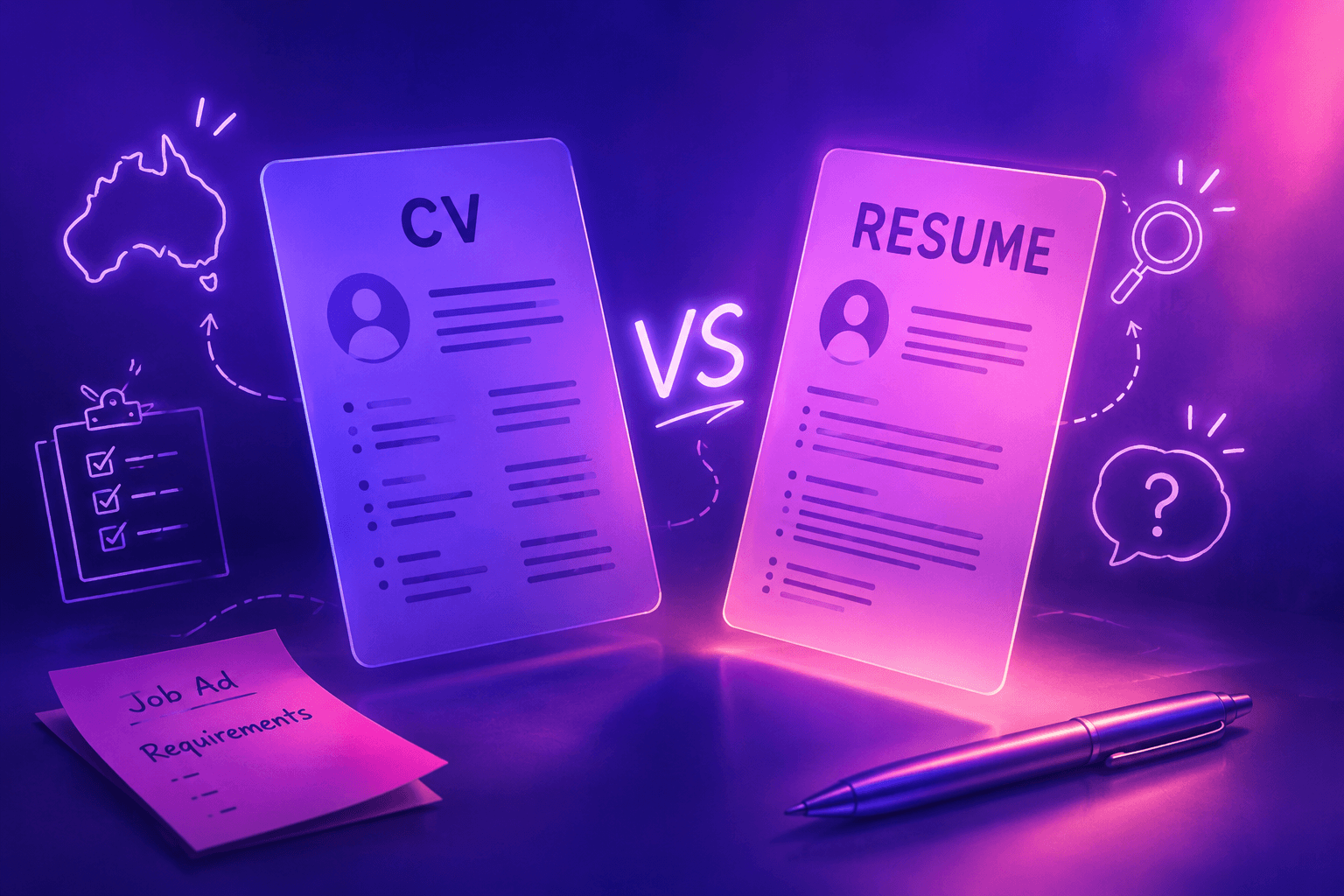
Table of contents
If you've ever stared at a job application form wondering whether to upload your "CV" or your "resume," you're not overthinking it. The terms genuinely overlap in Australia, but there are a few situations where the difference matters more than you'd expect.
Here's the short version: in Australia, "CV" and "resume" are used interchangeably for almost every job application. Most employers mean the same one to three page document regardless of which word they use. The exception is academic, research, medical and some senior government roles, where a genuine CV (a longer, comprehensive record of your career) may be expected. For a detailed breakdown of government applications specifically, see How to Write a Resume for NSW Government Jobs.
Why the Confusion Exists
The terminology split comes down to geography, not meaning.
In the United States and Canada, "resume" and "CV" refer to two distinct documents. A resume is short and tailored to a specific role. A CV is long, comprehensive, and used almost exclusively for academic or research positions.
In the United Kingdom, Ireland and New Zealand, "CV" is the default term for what Australians and Americans would call a resume: a concise, role-specific document.
Australia sits in the middle. Job seekers and employers use both words, often without meaning anything different by them. That's exactly why so many people searching for clarity end up more confused, not less. The advice they find online is frequently written for a US or UK audience where the distinction actually matters.
When Employers Actually Mean Something Specific
There are a handful of cases where an Australian employer genuinely wants a CV in the traditional sense:
- Academic and research roles. Universities and research institutions expect a full CV listing publications, grants, teaching history and conference presentations.
- Medical and specialist clinical roles. Some hospital and specialist positions request a CV format that captures qualifications, registrations and clinical experience in more depth than a standard resume.
- Senior government and statutory appointments. A small number of senior public sector roles, particularly at the executive level, may request a CV alongside a statement addressing selection criteria.
- International applications. If you're applying to a company based in the UK, Ireland or New Zealand, they may use "CV" to mean exactly what you'd call a resume, so don't assume it needs to be longer.
What Most Australian Employers Expect by Default
For the vast majority of roles, including corporate, trades, healthcare, hospitality, retail and standard government positions, Australian employers expect a document between one and three pages, occasionally stretching to four for very senior or technical roles. This holds whether the job ad says "submit your resume" or "submit your CV." Don't let the word choice push you toward writing something longer or more academic than the role calls for.
- Reverse chronological work history, most recent role first
- A short professional summary at the top
- Skills and achievements relevant to the specific job, not your entire career
- Clean, ATS-readable formatting without tables, columns or graphics
How to Tell From the Job Ad Which One They Want
A few quick signals to check before you apply:
- Look at the industry. Academia, research, medicine and senior government are the main categories where a genuine CV format may be expected.
- Check the application portal. Government job portals sometimes specify a CV alongside a separate response to capability requirements. That's different from a private-sector resume.
- Read any formatting guidance in the ad. If it mentions page limits, publications, or a specific structure, that's a strong signal they mean a genuine CV, not just using the word loosely.
- When in doubt, default to a resume. For the overwhelming majority of Australian job applications, a tailored one to three page resume performs better than an over-long, academic-style document that buries your relevant experience.
Frequently Asked Questions
Do I need a CV for a graduate job in Australia? No. Graduate roles almost always expect a standard resume: one to two pages, focused on your most relevant experience, education and skills. A lengthy CV format will work against you here, as recruiters are scanning quickly for relevance, not reading a full academic record.
Is a CV the same as a resume for NSW government jobs? For most NSW government roles, yes. You'll submit a resume alongside responses to the role's capability requirements. Only some senior executive-level positions request a more traditional, comprehensive CV. See our full guide: How to Write a Resume for NSW Government Jobs.
Will I be penalised for submitting a CV when a resume was expected, or vice versa? Not usually, since the terms are used loosely. What matters more is whether the content and length match what the role actually needs. A three-page academic-style document for a retail management role will hurt you regardless of what you called it.
Should I keep two versions (a CV and a resume) ready to go? If you're applying broadly across industries, it's worth having a tailored resume for standard applications and a fuller CV ready for the roles that genuinely call for one.
What's the biggest mistake people make with CV vs resume in Australia? Assuming the word used in the job ad dictates the format. Read the actual requirements of the role and industry, not just the label.
Just Koalapply!
Applying for different types of roles at once? Koalapply tailors your resume to the specific language and requirements of each job in minutes, so you're never sending the same generic document twice. For tips on doing this efficiently, read How to Tailor Your Resume Without Starting From Scratch.
Let us help you with your first application for free!